Inclusive Cultures Blog – Thinking with boxes: on freedom, creativity and building a professional identity
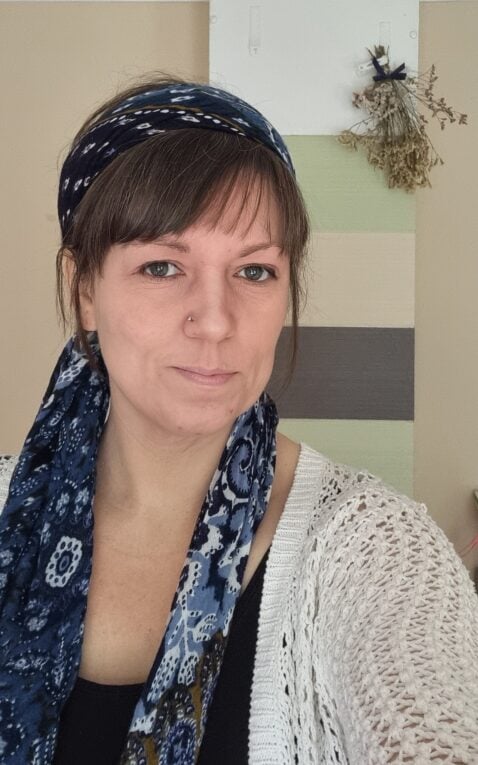
2024 Inclusive Cultures participant Steph Roberts reflects on her first few sessions and the influence of boxes in her working life.
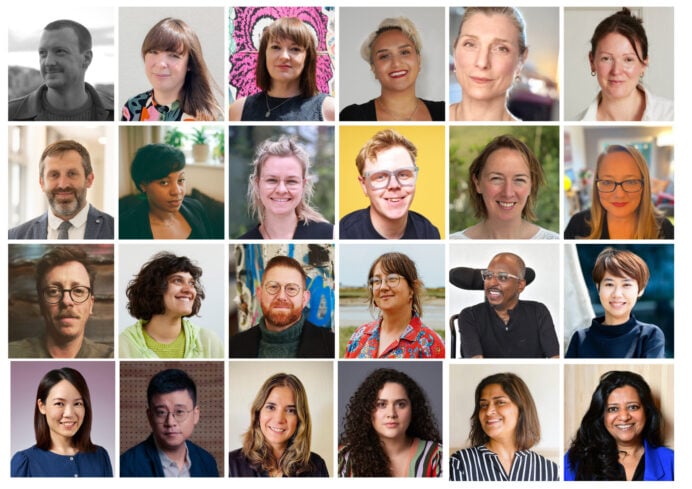
It’s the third day of Inclusive Cultures. I’m looking at my laptop. Thirty cultural leaders from all around the UK congregated on Zoom. A fleeting thought: we are, all of us, surrounded by boxes. For a moment, that’s all I can see. On the screen: boxes in windows and windows in boxes. Rectangular spaces framing faces, all of us together – thumbnailed – nestled neatly on the screen, each claiming our stake in this perfectly regular, perfectly consistent digital space.
As we move through the programme, I find myself thinking with boxes. They creep into my thoughts, give shape to the themes we explore in group conversations: structure, identity, disability justice, leadership, power dynamics. Who we are and what on earth we’re doing here. How we all fit together.
Inclusive Cultures gives me permission to explore this kind of metaphorical sense-making. Under the direction of our coaches and facilitators, we are encouraged to re-imagine our professional sphere with curiosity and creativity, drawing on metaphors and alternative imaginings. The organic: seeds, roots, growth. The structural: tensegrity, consent circles, horizons.
My mind keeps going back to boxes. Inevitably, perhaps. I am currently moving house, and they are everywhere, cluttering my physical and digital space. I sift through boxes from the attic: portals to the past, cardboard soft with age. There is something inherently human about a soft-battered cardboard box, I think. An honesty in the gently crushed edge – not separate from but breathing into the spaces around them.
I’ve got a complex relationship with boxes. As someone with a chronic health condition, I’ve spent a lot of my time boxed in my bedroom. The soft-boxed platform of my bed is often how I access work: my laptop screen perched on my knees, a digital portal into the other world. Open tabs stacked like cards, faces of colleagues in boxes on screens.
I am tired of boxes, of being boxed up.
Something in me rallies against their illusory neatness and conformity. The divisions, the walls. The way they curtail and exclude. At the same time – are you kidding? I LOVE boxes. The administrator in me could spend hours arranging things in boxes, moving things from one to another. In Excel, my pill box, my diary. It’s so satisfying – this endless arranging and re-arranging, a controlled spatial re-imagining.
For a long time, I’ve laboured in institutional boxes. Organised hierarchies: people stacked upon people. Here’s the staff chart – this is you. See who’s above, who below. Here are the power dynamics, laid bare. The direction of decisions, the weighting of responsibility. Everything so simple – on paper.
Except people and their relationships are not easily boxed. We have our distinct shapes. We’re networked, connected – not separate forms. We move, vibrate, expand. We do things that are beyond what it says on our box (sometimes through rebellion, sometimes force). We are invited to ‘think outside the [corporate] box’ while simultaneously being suffocated by it. Some boxes explode at the seams or are crushed under the weight of those stacked above. Working with institutional boxes will always be something of an illusion: a fallacy of social organisation.
Here’s a conundrum: what happens when you leave an institution, and find yourself unexpectedly box-less? I left a permanent salaried position to go freelance in 2022. I’d out-grown my institutional box: I felt cramped, mis-shaped. I was also newly disabled, though it took a while for me to claim that particular box. I kept asking am I disabled enough? or in the right ways? – all the while knowing these are not the questions that need to be asked.
Remote working is my main access need. A simple request – but in a world that priorities in-person work, opportunities are hard to find. And in-person work is difficult when there are no rest spaces, quiet places, or spaces to recuperate and tend to our bodily symptoms – at least with any kind of dignity. A cramped toilet stall doesn’t cut it. I return to the questions we were posed in our introductory session on interpellation vs inclusion: ‘Who furnished the space we are being invited into? Will it really work for us?’
These are the questions that really need to be asked. It’s never just about the box – it’s also about the space that holds it (or not). This is especially true for disabled or otherwise marginalised practitioners And, if the space doesn’t work for us – or the systemic ableist privileging crushes us, or resigns us to the margins – well, while we’re there we may as well play. Because some of us might not want a box at all. Some of us might want a bed, a hammock, or a beanbag.
‘The object has fundamentally changed my access, my practice and the space in which I work is a beanbag’ shared Rachel Bagshaw in one of our sessions. ‘.. That cushioning, a squishy space with softer corners and room to move around in, is exactly what I need.’
Working from the margins, outside of a single institution, has given me the opportunity to define my own boxes – to shape, deconstruct and build my professional identity anew. What are you doing these days? people ask. I have no straightforward answer. I’m a curator, writer, facilitator, researcher, advocate, ally, administrator, thinker, producer, rester [yes, rester]. It depends who’s asking, when, and why.
These days I exist on the outskirts: an outlier, leading from the sides. I am no longer part of a fixed hierarchy, have no linear responsibility over others – apart from the responsibility of ethics and care so crucial to us all. Inclusive Cultures gave me the confidence to be more playful in thinking with boxes. To embrace the soft-battered, the hand-built, the make-do. And sometimes to do away with boxes altogether, and start thinking in beanbags instead.
Steph Roberts
My participation in Inclusive Cultures 2024 was enabled by a grant from Arts Council of Wales Creative Steps, a National Lottery Arts Funding programme. With many thanks for their support. My gratitude also to my peer group – Fiona Byrne, J Neve Harrington, Claire Teasdale, Dora Colquhoun and our brilliant coach Hayley Hindle – for our many rich and deeply nourishing group conversations.
Themes Inclusive Leadership Practice Leadership Styles Practices of Self Care