Coaching reflection: a deep-dive into the potential and pitfalls of group coaching
What is group coaching? What makes a good coach? Is group coaching right for me? Rowena Price answers these questions and more as she reflects on her experience working as a coach and participating in group coaching sessions.
In 2023, I spent 6 months taking part in regular group coaching sessions with two separate groups – as the coach/facilitator in one, and as a coachee in the other. Here’s what I learned…
Anxiety, thy name is the hungover regret of oversharing in an environment not conducive to psychological safety.
I’m having flashbacks to the year 1999. My left hamstring is screaming at me (still does) after succumbing to a lame dare to do an even more lame party trick – the splits (sorry) – in front of the group without warming up. The stench of warm Red Stripe/Lambrini is stinking out the front room. My mind is reeling over the secret I just divulged (under duress), and the effing bottle is effing spinning again. I don’t want to share and I don’t want to dare, and I’m worried about coming face to face with the same group in double maths the next morning. I feel a bit sick and want to cry.
A formative experience of what it means (or can mean) to sit in a circle with your peers and *shudder* become seen. And enough to put anyone off a group ‘sharing’ situation for life. Plus, I’ve always preferred one-to-one social situations.
Fast-forward to 2024. I’m scarred for life, obviously, but finally able to talk about it. And ready to share some thoughts on ‘sharing with the group’, having overcome my fears and given group coaching a go.
Sitting comfortably? Got what you need? Great. Let’s begin…
What is group coaching?
For the purposes of this piece, I’m defining group coaching as: a facilitated space in which a small group (approximately 5-10 people) convene, listen and share thoughts and experiences to explore and/or address challenges. A space for connection, albeit less like my truth or dare analogy than I’d hoped when I started writing this.
By no means a new phenomenon, but perhaps less commonplace than one-to-one coaching at work, group coaching can be set up and delivered in different ways. Action learning sets facilitate collaborative problem-solving. Listening circles make the space for simple and powerful sharing – being seen and heard, bearing witness, without the burden of problem-solving. Other group coaching approaches are available, but what links them all is that they’re designed as psychologically safe spaces, intentionally facilitated to cultivate deeper listening and, inevitably, deeper learning.
As a practising coach of five years (alongside communications consultancy), I’m not a novice, but relatively fledgling compared to some; still hungry for new experiences, but fundamentally sold on the concept of coaching as a tool for transformation. So when the opportunity arose last year to explore different types of group coaching concurrently and in different roles – not something I’d done before – I jumped at the chance. Richer insights ahoy!
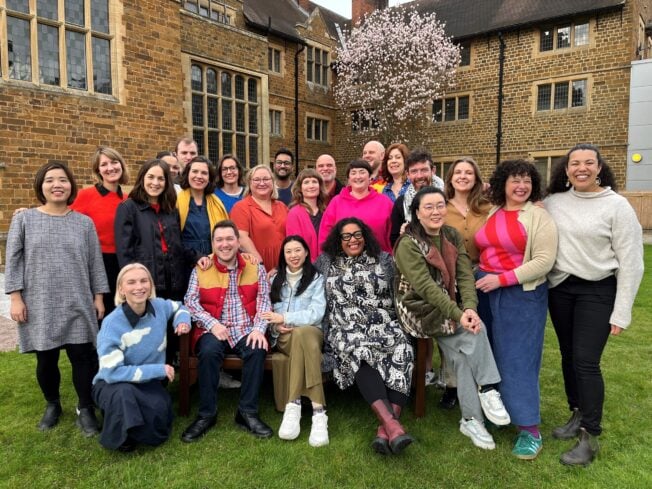
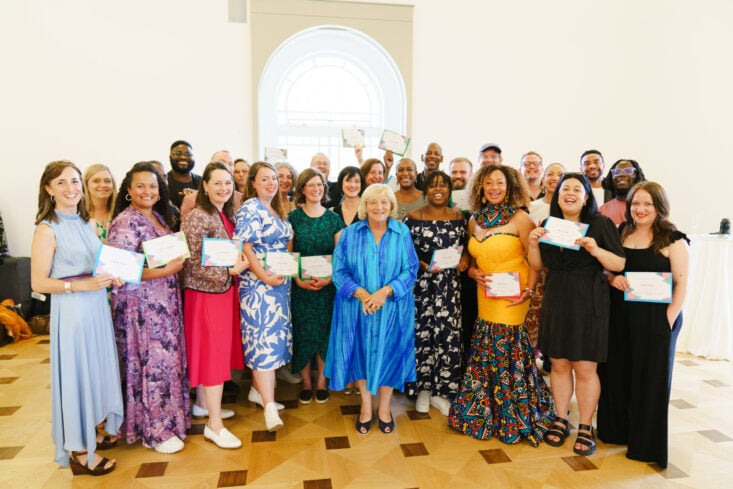
For context: the group coaching I took part in was as a participant in Clore Leadership’s 2023 Inclusive Cultures programme – a six-month professional development programme designed for cultural leaders seeking to enhance and expand their approach to inclusive culture-making and transformation. The group coaching I facilitated was for a small organisation as part of a wider programme of work, including a listening circle and team coaching with senior management (any insights from which have been shared with express permission of the client, with details changed and anonymised).
Across these experiences – and others – there have been tears (not always a bad thing), laughter, shocks, surprises, golden silences, mic-drop moments and more.
Here’s what I’ve learned about both the potential and the potential pitfalls of group coaching…
#1 Embrace the warmth of campfire mentality
The circle is a powerful symbol as old as time. Think campfires, AA meetings, fabled round tables. And, yes, teenage games of truth or dare (eek). We are one, the circle says. We are connected. We are equal. This campfire mentality – the instinct to come together in a circle, to share, to connect, on a level – is baked into our collective DNA as human beings.
So in some ways, it’s baffling that we don’t ‘commune’ in this way at work more often (the universal barriers of lack of time, overwhelm and constant games of whac-a-mole notwithstanding). What are we missing out on, I wonder?
I don’t mean the weekly team meeting where everyone reads the contents of their Outlook calendar out loud, then frantically flips through the rolodex in their brain for a ‘highlight’ from the previous week. Those sorts of meetings, although not without purpose, can, at times, be bizarrely dispiriting. Frustrating, even. Surface information sharing has a purpose and I’m not advocating doing away with those meetings. But there’s little room for revealing, let alone understanding, what folks are really grappling with. Sometimes we need the campfire, a shared experience that helps us transcend the mundane day-to-day.
Enter, you’ve guessed it: group coaching.
#2 Set the scene before holding the space
I often revisit the phrase ‘fluffy goal, fluffy session’ – something one of the trainers used to say when I did my coaching training. A cautionary nod to the pitfalls, missed opportunities, and unfulfilled potential we risk when we go in with the spirit of vagueness.
As with any type of communications work – and coaching is nothing if not the work of communication – getting clear on the Five W’s (who, what, where, when, why) from the outset is a helpful exercise if you want the work to fulfil its potential. It’s also useful to take the time to define what that success looks like to you.
Who is taking part? What type of group coaching is likely to best serve the group? Where will the coaching take place and how might that environment affect accessibility and experience? Likewise, when will it take place, and what might you need to consider in that respect? And most importantly, why are you doing this? And why now? Intention and timing are key.
Beware mission creep
If you’re the person initiating the group coaching, the people involved and the process itself are more likely to fulfil their potential if you consider the Five W’s carefully. But beware. Having made the mistake in the past of not revisiting those conclusions along the way (thus presiding over an unnecessary tangle of crossed wires and unmanaged expectations), I’ve learned that ‘mission creep’ is not uncommon and definitely something to look out for.
Taking moments for reflection to check that you’re all on the same page can apply within a single session, but is arguably even more important to do if you’re doing a series of sessions with a group. It can mean the difference between people feeling connected with the experience versus feeling lost and frustrated.
#3 Sharing is daring
If you’re responsible for holding the space as the coach or facilitator, coaching 101 rightly dictates that proactively nurturing a psychologically safe space (not just at the beginning of the process but throughout) is a non-negotiable.
“I have found consistently that Thinking Environments are places that simply say back to people: you matter”, says Nancy Klein, author of Time To Think (1999).
I agree, and consider ‘thinking’ a catch-all for sharing, listening, coaching and collective problem-solving here too.
Group coaching can be exposing. The dynamics of hierarchy in the room, for example, can affect how free people feel to share. Which is why it’s important to do the due diligence pre-work (see section #2) before jumping in. Courage calls to courage as they say, and with risk comes reward. The pay-off of being brave and sharing in a safe space is the feeling of being seen, heard and acknowledged. Like you matter, because you do.
Are you listening carefully?
“We think we listen, but very rarely do we listen with real understanding, true empathy. Yet listening, of this very special kind, is one of the most potent forces for change that I know.” – Carl Rogers
Different types of group coaching are suited to different circumstances. With my aforementioned client, we opted to try a listening circle format. For the uninitiated, a listening circle is a facilitated format for holding space for people to take turns speaking in a circle, employing specific questions as prompts – a methodology developed by psychologist Carl Rogers, first introduced to me by my coaching trainer Debs Barnard of Relational Dynamics 1st.
In practice with my client, the listening circle meant meeting once a month for an hour or so. Everyone takes turns of 2-3 min each to share whatever is on their mind. Then you go round again with the framing: ‘where’s your thinking at now in relation to what you said or heard in round one?’ And then a third and final round, sharing ‘what you’ve appreciated’ or ‘what resonated’ or ‘what you’re taking away’. Showing up, meeting people where they’re at, making space for true attentiveness. “Connecting with colleagues in a way we rarely get to do in other contexts”, as a listening circle participant recently put it.
“Rogers theorised that when speakers feel that listeners are being empathic, attentive, and non-judgmental, they relax and share their inner feelings and thoughts without worrying about what listeners will think of them. This safe state enables speakers to delve deeper into their consciousness and discover new insights about themselves.”
It’s worth noting that a listening circle can stray into more of a therapeutic realm, so proceed with awareness. Some might not consider it under the umbrella of coaching. In my client’s case, the way we approached it was to apply coaching principals to the before and after, supporting the team to take action based on what came up, if appropriate, outside of that space. And the positive ripple effects are beginning to be felt: deeper insights, and an evolution in team dynamics, helping people to work better together.
You’re free to leave at any time
When our coach on Inclusive Cultures opened our first coaching session, he went out of his way to set and subsequently manage expectations for the space we shared and our roles within it. This might seem like basic good practice, but I’m not sure it’s always a given. He established and maintained trust through transparent and consistent communication in the sessions that followed.
When I found myself in tears in the final session (I’d found an earlier, separate group discussion overly exposing and could feel the panic rising after what had been a long and difficult week), he didn’t rush to my immediate aid. He held the space. And then gently reminded me that stepping away was an option available to me at that moment. There was that whiff of room temperature Lambrini again, coming back to haunt me.
It’s good to step out of your comfort zone, but counterproductive to be in freeze mode. Rationally, I know this. As a coach, I will encourage clients to pay attention to those differing states and perhaps let it inform what they do next. It’s humbling to be back on the other side of things, lizard brain taking over. His proactive approach helped me get more out of that experience because, him having reminded me that I could leave, I felt anchored to the reality of the moment and safer to stay. We all need reminding of what we think we already know sometimes. Kudos to our excellent coach, and to the rest of the group who echoed that same sensibility.
As both a coach and a coachee, I’ve found the job of adapting according to the energy in the room to be harder in a group setting rather than one-on-one. More people, more variables (quelle surprise). I’ve learned that I feel more comfortable as a coach than a coachee in group settings, perhaps because of the illusion of control whilst in that responsible role of space holding. And it is an illusion. Taking part feels more exposing. I wonder if any coaches reading this have ever felt the same?
It’s worth considering what you need to support you to do your best work and honour the process and the people involved – what might help you (before, during and after the session) to remain agile and adaptable as you hold the space?
#4 Beware the beast of burden
‘A problem shared is a problem halved’, as the saying goes. But I’m beginning to wonder if this particular proverb is in need of a rewrite (or at least having a caveat attached). For some the circle can descend into a spiral.
Access-wise, a group setting can sometimes be a genuine barrier to engagement (regardless of whether you’re in person or remote), and throw up additional challenges.
I have found that cognitive load/overwhelm can be more likely, for example. In my role as coach and facilitator over the years, I have wrestled with the sense of responsibility in such spiral moments: Could I have done anything differently in the set up? What can I do now? What, if anything, could I do differently next time? When I brought this to a coaching supervision session, my supervisor helped me reconnect with the difference between being responsible to and responsible for.
Once again, this brings me back to the importance of due diligence in the set-up and stewardship of the space. Things that can make a difference: follow up sessions one-to-one where appropriate, support workers being present, perhaps taking notes, or planning ahead to create provision for follow on work or even referrals. But not forcing it. I have had clients who have set up access to free/low-cost counselling in case anyone needed it. Because things can sometimes get heavy and it’s important to acknowledge when something different might be required. In spite of the sometimes therapeutic effects, coaching is not therapy.
#5 Complete the listening loop
Far be it from me to rinse an analogy for all it’s worth, but I’m going to stick with circles because they’re apt and I like them (these days). No coaching practice or experience is complete without the listening going full circle, and by that I mean: seeking feedback and listening to it. Extending the principals of the process to the process itself.
After six months of holding monthly listening circles with my client, we paused to take stock. With input from the person who commissioned the work, we carried out a short online survey, with the option for a chat if preferred, to get a sense how people felt about the experience, if and how we might move forward.
Not everyone wanted to continue with the process, and it was important to hear that and consider how to move forward inclusively. Others felt pretty galvanised and wanted to continue, and some useful insights emerged about specific themes we might go on to explore using the listening circle format more flexibly. We’ve since found a way to continue without it being either/or.
What are you taking away from this experience?
Unlike truth or dare, group coaching, in its various forms, has enormous potential to help people and create the conditions for teams to do their best work. It can:
- Accelerate and deepen bonds within the team in ways that a work social or your weekly team meeting can’t (valuable as they both are), thanks to the pace of and space around the sharing;
- Foster empathy with a greater sense of context and awareness outside of individual bubbles or one-to-one dynamics;
- Lighten the individual load, helping us to feel less alone when challenges arise;
- Unearth multiple perspectives on the same issue, enriching and evolving thinking;
- Inform collective problem solving in a methodical, spacious and non-judgemental way;
- Give us a chance to bear witness with greater attentiveness.
I’m not so delusional as to believe that we can ever wrestle ultimate control over processes like this – humans are involved so by default things can get messy. The potential pitfalls remain points for awareness, rather than avoidance:
- The beast of burden is real! There’s a risk that participants might leave the space feeling counterproductively overburdened or overwhelmed;
- It can be exposing – even when the intention to create a safe space is present;
- It can be an unruly experience to navigate and wrangle – it’s not a given that everyone will be or stay aligned and connected with the process, and that can make for a perversely isolating experience for some.
Group settings for sharing and problem solving aren’t for everyone. But we might as well look for the magic in the mess where we can, and learn from the things that didn’t go so well.
As much as my formative truth or dare experiences were a cautionary tale as well as being a rite of passage (I’m over it, I promise), they did plant a seed of curiosity that I’m grateful for, and serve as a reminder that the simple act of coming together, turning our attention to each other, has the power to propel us forward in ways we never imagined possible. Even if it does take a little time for the true outcomes to emerge.
Rowena Price is a Communications Consultant and Coach working across the arts and creative industries, and a Clore Leadership alumna (2016). www.rowenaprice.com
Themes Coaching & Mentoring Hard Skills Qualities of Leadership